Someone in your city might be standing in their driveway right now, looking at where their old doorbell used to be, and typing “security camera installation near me” into their phone.
And they’re most likely going to call one of the top three results they see on Google. If your business isn’t in that Google Map Pack, you’re likely not in the conversation at all.
Around 76% of people who search for something nearby on their phone visit or contact a business within 24 hours. For CCTV and security camera installers, that number could be higher, because the search often follows a break-in or a break-in scare. There’s real urgency behind the click.
The good news is local SEO for CCTV installation companies isn’t especially complicated. It just tends to get skipped or half-done. Many competitors probably have a generic Google Business Profile, a website that doesn’t say much, and a small pile of old reviews.
If you’re willing to do the boring work consistently, you can often outrank them faster than you’d expect. This guide walks you through the exact system I’d use.
Have a security camera installation business? Book your free audit below.
Why Does Local SEO Matter So Much for a CCTV Installation Business?
Security camera installers tend to run into a specific problem. There’s no storefront your customers drive past. Almost every job usually starts with a search, a referral, or a Nextdoor thread.
Local SEO is the work of making your business show up when someone nearby searches for the service you offer. For a CCTV installer, that means appearing for queries like “security camera installation near me,” “companies that install security cameras,” “CCTV service [city],” or “commercial security camera installer.”
Two places tend to matter here. The first is the Local Pack, that box with three businesses and a map at the top of the results. The second is the regular organic listings underneath it.
The Local Pack is often where the phone actually rings. If you’re not in that box, you may be competing for the leftovers underneath.

What Actually Drives Rankings for a CCTV Installer?
Google ranks local businesses on three factors: relevance, distance, and prominence. Distance is what Google calculates on its own based on where the searcher is. You can’t really move your service radius closer to every homeowner in the city, but you can shape the other two quite a bit.
Relevance is about telling Google what you do. That’s your primary category, your services list, your website copy, and even the photos you upload of finished installs. Prominence is roughly your reputation on the internet: reviews, citations, mentions, and how active your profile looks.
A Real Case Study: Dr. Computer Services in Houston
Before we get into steps, let me show you what this can look like in practice. One of my clients is a security camera installation business in Houston, Texas. Houston is a competitive market for this service. When we started, their profile was underused, their site didn’t have enough service pages to reinforce what they did, and they had limited blog content.
We didn’t do anything fancy. We optimized the Google Business Profile.
Here’s what the Google Business Profile side looked like over the five months period (Dec 2025 through Apr 2026):
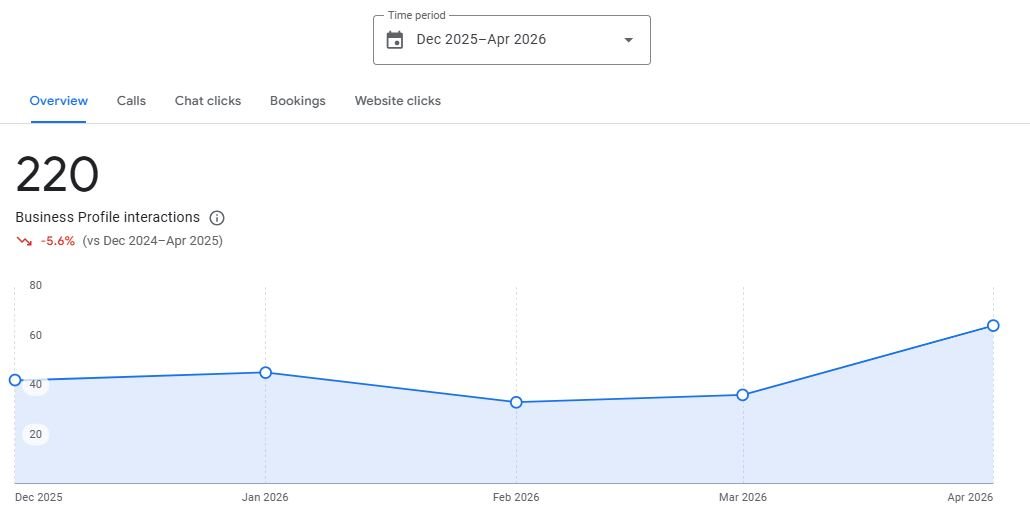
The important part of that chart isn’t the total number by itself. It’s the shape. February softened (probably a seasonal dip common in this trade around tax time), then March held, and April jumped to the highest month in the window.
Here’s the search side, from a website visibility snapshot:
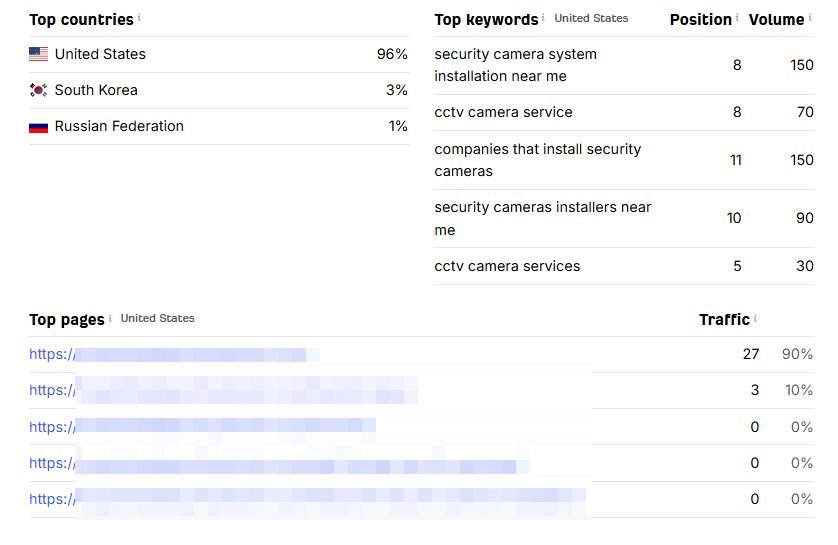
Traffic is 96% United States, which is exactly the audience you want (not off-target). The tracked keywords are all high commercial intent — someone typing “companies that install security cameras” isn’t researching; they’re more likely to make a buying decision.
And the site is on page one for five of those queries at a time, with the top page carrying 90% of the traffic, which is the pattern you want to see when a service or homepage is doing its job.
A summary of what that produced:
| Metric | Result | Notes |
|---|---|---|
| GBP interactions (5 months) | 220 | Steady baseline; April was the strongest month |
| Page-1 rankings | 5 core keywords | Positions 5–11 for commercial-intent CCTV queries |
| Best-performing keyword | “cctv camera services” — pos 5 | |
| US traffic share | 96% | Clean, on-target audience |
Nothing exotic. Just the boring work applied to the right things. Your market, competition, and starting point will look different, and results in another city could land higher or lower, but the pattern of what moved the needle is what to pay attention to.
Get a Free Local SEO Audit →
Here’s how you can optimize your security camera installation business for search.
Step 1: Fix Your Google Business Profile First
Your Google Business Profile (GBP) is arguably the most important asset in this whole system. It’s usually what gets you into the Local Pack, and it’s free. If you haven’t claimed yours yet, go to google.com/business and do that first.
Once you’ve claimed it, the work is mostly filling out every important detail accurately. A few things to keep in mind for CCTV businesses specifically:
- Set the right primary category. Check your top 3 competitors and notice their primary category. You want to select the most appropriate primary category for your business.
- Define your service area properly. Don’t hide behind a home or warehouse address. An address is important if you have one. But also enter the cities and neighborhoods you actually serve.
- Fill in every service. Home security camera installation, commercial CCTV, camera upgrades, existing system repair, remote-access setup, doorbell camera installation, business security assessment. Each is a keyword Google can match you to. Add a short description under each.
- Upload real photos of installs. Wide shots of a finished camera at a home, a control panel, a business rack, a service van. Not stock. A homeowner comparing three profiles will often trust the one that shows real work over the one with a generic logo alone.
- Post weekly. A short note about a job you just finished, a seasonal reminder (holidays, back-to-school, summer travel), or a tip about camera placement. Posts aren’t a direct ranking factor as far as anyone can tell, but they can lift engagement, and engagement signals seem to matter more each year.
For a much deeper walkthrough of the profile itself, our step-by-step Google Business Profile guide covers every field and setting worth touching.
Step 2: Build Service Pages That Match Real Searches
A GBP alone can only carry you so far. I think Google cross-checks your profile against the website it links to, and if your site is a thin one-pager, you may be leaving prominence on the table. You don’t need a beautiful site to rank. You need a useful one.
Here’s the structure I’d suggest for CCTV installers for important pages:
- Homepage: Clearly says what you do, where you serve, and why someone should call you. Phone number in the header, ideally above the fold.
- A service page for each service you offer: “Home security camera installation in [city],” “Commercial CCTV installation in [city],” “Doorbell camera install in [city],” “Business security assessment in [city].” Not lumped together. Separate pages, each targeting one search intent.
- Location or service-area pages: If you serve multiple cities or neighborhoods, a page for each one, written for that area.
- A contact page: Phone, service area map, form, hours, and a note on whether you offer free on-site quotes.
- NAP in the footer: Your name, service area, and phone on every page. This reinforces consistency for Google.
Step 3: Nail Your NAP and Local Citations
NAP stands for Name, Address, and Phone. Sounds obvious. It isn’t. One of the most common local SEO problems is a business whose NAP looks slightly different on ten different websites. “Suite 200” versus “Ste 200.” A cell phone on Yelp and a landline on the site. A business name with “LLC” on one directory and without it on another.
Each mismatch can be a small dent in Google’s confidence that you’re one clear business. Enough of them and your prominence signals may start to suffer.
Try to fix this in order:
- Decide the canonical version once. Exact name, exact format, exact phone. Write it down.
- Update the five that tend to matter most first: Google Business Profile, your website (in the footer and contact page), Yelp, Facebook, and Apple Maps. These are usually the anchor citations.
- Add security-relevant directories after that: Angi, HomeAdvisor, BBB, Nextdoor, Thumbtack, local chambers, and any electrician or low-voltage association listings. Quality over quantity here.
- Audit quarterly. Old franchise listings and duplicate profiles can sneak in over time, especially if you’ve rebranded or changed phone numbers.
I’m not sure most business owners realize how much of the local SEO fight happens in these small consistency details, but they seem to add up over time.
Step 4: Build a Steady Review Habit (Not a One-Time Push)
Reviews are widely considered one of the stronger prominence signals in local search. It looks less about hitting a magic total count now, and more about velocity and recency. A CCTV company with 400 reviews and nothing new since last year can lose to a competitor with 60 reviews from the past 60 days.
Here’s the system I’d put in place for a CCTV installation client:
- A direct review link. Not a link to the GBP profile page. A one-click Google review URL. You can grab it from your GBP dashboard.
- A text message ask, not email. CCTV customers are usually on their phone right after the install, watching the live feed for the first time. I think text will get a better response than an email.
- Sent the same day, not a week later. Ideally within an hour of the install being done, while the “wow, I can see everything” moment is still fresh.
- A short, human ask. Something like: “Glad we got you set up today. If you have 30 seconds, a quick Google review helps a ton: [link]”
- Reply to every one. Positive and negative. A calm, factual reply to a critical review can build your trust rather than hurt you.
A consistent trickle, rather than a burst, is usually the better goal. I think two or three fresh reviews a week over six months are more valuable than fifty reviews in one weekend.
Step 5: Add Schema Markup to Your Site
Schema markup is a small block of code that tells Google who you are in a more structured way. For CCTV installers, there’s no perfect built-in type, but HomeAndConstructionBusiness (a subtype of LocalBusiness) should work well, and Google accepts it. It communicates your business name, service area, phone, hours, and services more directly to search engines.
You don’t have to write it from scratch. If you’re on WordPress, Rank Math or Yoast can generate most of it once you fill in the fields. On a simpler builder, you can paste a JSON-LD snippet into the site header. Here’s a template you can adapt:
<script type="application/ld+json">
{
  "@context": "https://schema.org",
  "@type": "HomeAndConstructionBusiness",
  "name": "Your Security Camera Installation Business",
  "description": "Residential and commercial CCTV and security camera installation.",
  "telephone": "+1-xxx-xxx-xxxx",
  "url": "https://yourwebsite.com",
  "priceRange": "$$",
  "areaServed": [
    { "@type": "City", "name": "Your City" },
    { "@type": "City", "name": "Neighboring City" }
  ],
  "openingHours": "Mo-Sa 08:00-18:00",
  "address": {
    "@type": "PostalAddress",
    "addressLocality": "Your City",
    "addressRegion": "Your State",
    "addressCountry": "US"
  },
  "hasOfferCatalog": {
    "@type": "OfferCatalog",
    "name": "Security Camera Services",
    "itemListElement": [
      { "@type": "Offer", "itemOffered": { "@type": "Service", "name": "Home Security Camera Installation" } },
      { "@type": "Offer", "itemOffered": { "@type": "Service", "name": "Commercial CCTV Installation" } },
      { "@type": "Offer", "itemOffered": { "@type": "Service", "name": "Doorbell Camera Installation" } }
    ]
  }
}
</script>
Swap the placeholders for your real info. Five minutes of work, and it can remove a lot of guesswork on Google’s side. Or, simply ask a good AI chatbot, like Claude, to generate the schema markup code for your business.
How Does This Help You Show Up in Google’s AI Overviews?
Many of the same signals that support ranking in the Local Pack seem to be the ones that get you cited in AI Overviews and assistant answers.
When someone asks their phone “who installs security cameras near me,” the model usually isn’t inventing an answer. It tends to pull from structured business data, reviews, and service descriptions, then generates a recommendation.
I think a profile that’s accurate, active, well-reviewed, and aligned with a matching website is usually the kind of thing these systems seem to trust. In practice, that can mean:
- Complete, structured GBP data (categories, services, attributes) gives AI cleaner, more parseable information.
- Fresh reviews and posts help signal activity.
- Consistent NAP across the web reduces the chance the AI pulls stale or duplicated data.
- Service pages that clearly describe what you install (in plain language) give the AI passages it can quote directly.
Optimizing for the Local Pack and optimizing for AI answers aren’t completely different jobs; they overlap significantly. If your fundamentals are solid, both channels can start feeding you.
Common Mistakes to Avoid
- Keyword stuffing the business name. “Elite Best Security Camera Installation Houston LLC” isn’t clever, and it can be a suspension risk. Use your real legal name.
- One giant “Services” page listing everything. Splitting it into individual service pages tends to work better.
- Ignoring negative reviews. A silent business next to a review complaining about wiring or a missed appointment can look worse than one that responds calmly with facts.
- Copy-pasting city pages. Try to write each location page for that location, with real local landmarks, neighborhoods, or installation examples.
- No commercial-intent content. If your site only has residential examples but you actually want commercial CCTV work, Google is going to keep sending you homeowners. Write the pages you want to attract.
- Slow, cluttered mobile sites. Your customers are often on a phone. If your site takes six seconds to load, you may lose them before they see the phone number.
None of these are hard to fix. They’re just easy to overlook when you’re spending your days pulling wire.
Putting the System Together
Local SEO isn’t really a project you finish. It’s more of a habit you keep. To rank your business, keep doing the basics well, month after month:
- Weekly: A GBP post, a few new install photos, replies to any new reviews.
- After every job: A same-day review request via text.
- Monthly: A fresh service or location page, or an update to an existing one.
- Quarterly: A citation audit and a keyword check to see where new ranking opportunities may be opening up.
Do this consistently, and you’re likely to see more than just extra calls. Over time, you can become the security camera company Google is more willing to recommend, both in the Map Pack and in the AI answers.
Want a page-one result like the Houston case study for your CCTV business?
We build this whole system for security camera installers and local service businesses. Google Business Profile management, focused service pages, reviews, and the on-page SEO that ties it all together. Free audit first, no pressure.
Questions You Might Have
How long does local SEO take to work for a CCTV installation company?
You’ll often see the first ranking movement in about 60 to 90 days if the fundamentals are being worked on consistently. Getting into the top three of the Local Pack in a competitive city can take a few months. Once you rank in the top three, you can start getting leads without investing in any other marketing strategy.
Should I have separate pages for residential and commercial CCTV?
I think yes. Commercial and residential buyers might use different search language, care about different features, and have different decision cycles. Splitting them into two service pages usually beats one hybrid page for both audiences.
Do I need a website if my Google Business Profile is strong?
Yes. I think search engines like Google cross-reference your profile against a real website. A GBP with no supporting site (or a thin single-page site) often hits a ceiling. Even a simple five-page site with clear, city-specific service pages can meaningfully improve how you rank.
How do reviews affect my ranking exactly?
Your review count, average rating, review recency, and how you respond to reviews can affect your prominence signals. Recency and velocity are two big ones. A steady flow of new reviews signals an active, real business.
Read More: Local SEO Guide for Mobile Mechanics (With a Real Case Study)
Pingback: How to Optimize Your Google Business Profile (Step-by-step)